
Krafty Page ChronicleS • Issue 3 • July — Become • Stage IV: Flight
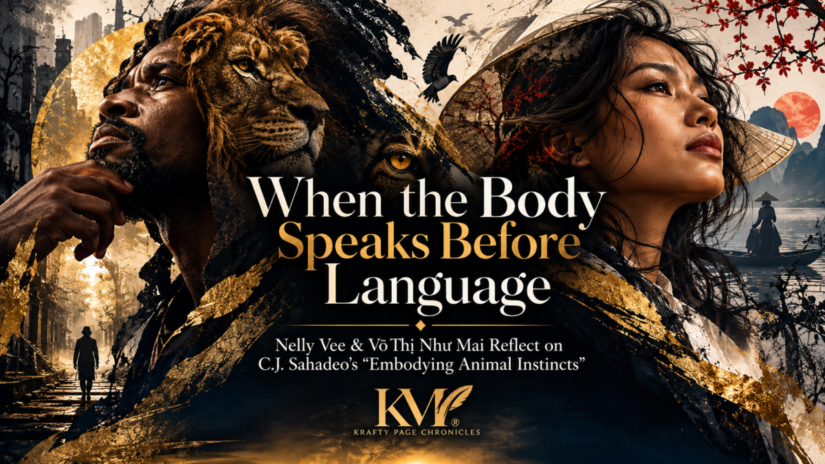
When the Body Speaks Before Language
Nelly Vee and Võ Thị Như Mai reflect on C.J. Sahadeo’s Embodying Animal Instincts: What It Reveals Beyond Language.
A joint editorial reflection by Nelly Vee & Võ Thị Như Mai
Featured Work • C.J. Sahadeo
Read the magazine feature first, then continue into the two cultural reflections below.
The Work at the Center
What Happens Before We Have Words for Fear?
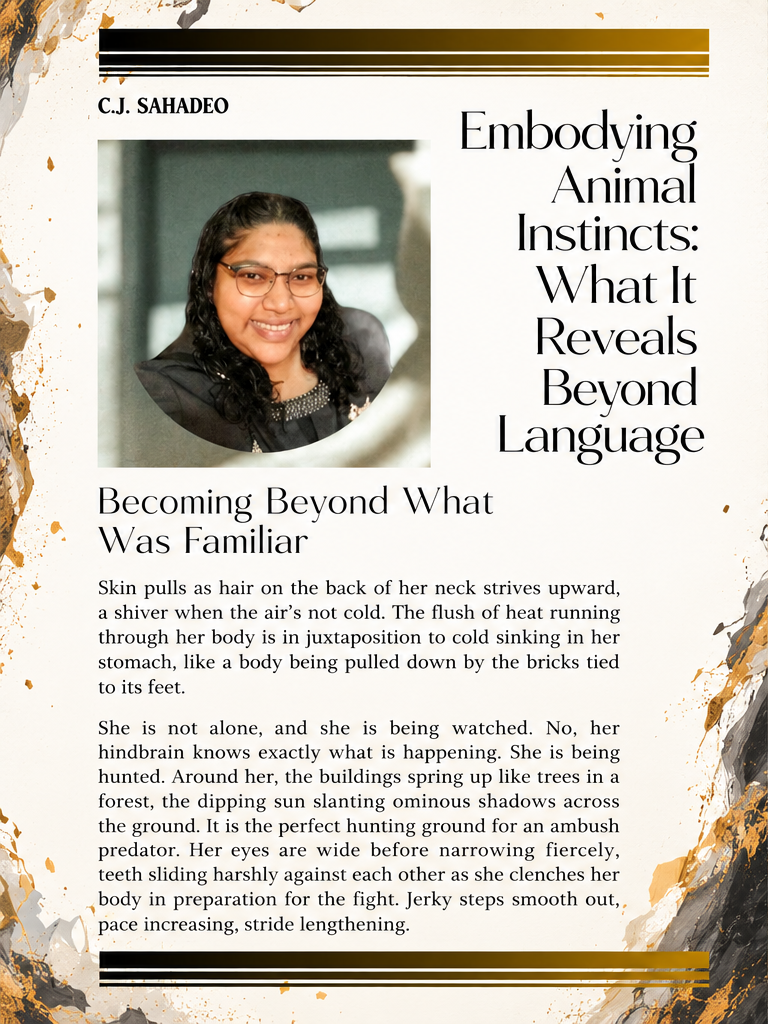
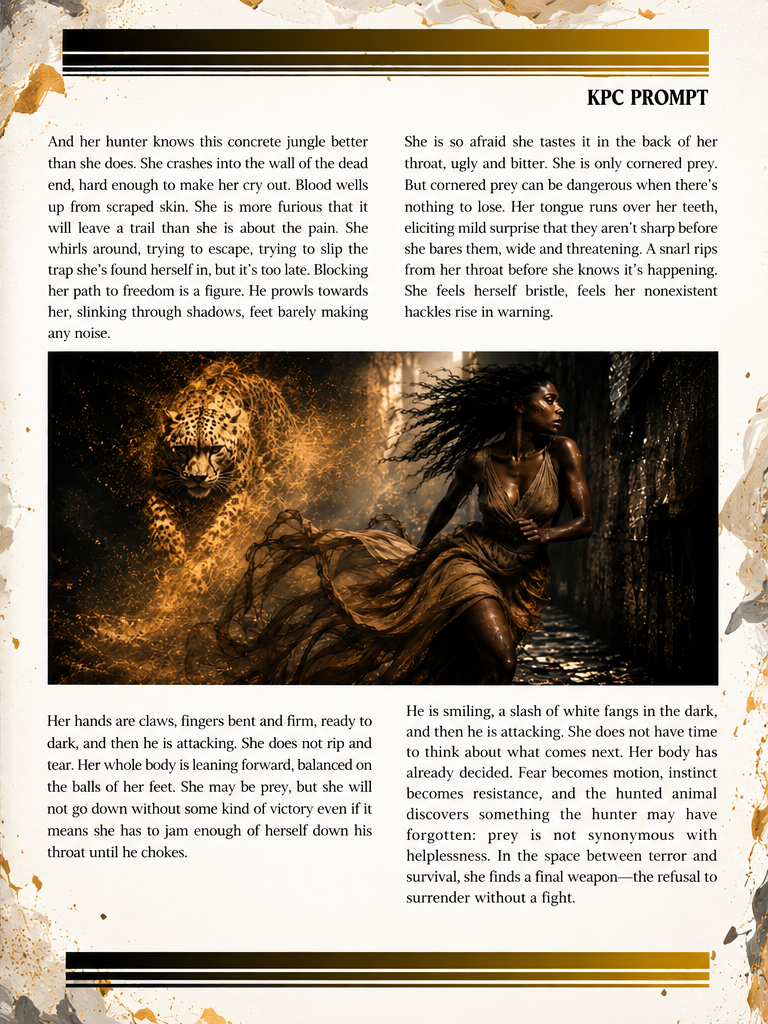
C.J. Sahadeo’s piece begins in the body. Skin tightens. Breath changes. Sound grows sharper. Movement becomes calculation before the mind has finished naming what is happening. The story asks a deceptively simple question: when danger strips away language, etiquette, and explanation, what remains?
The sympathetic nervous system helps prepare the body for intense physical demand, often described in everyday language as the “fight or flight” response (Alshak & Das, 2023). Sahadeo turns that physiology into literature, giving instinct a shape, a pace, and eventually a voice of its own.
Nelly’s Lens • Instinct, Identity & Control
Civilization Does Not Erase the Animal
What stands out to me is the collision between the person we believe ourselves to be and the organism underneath that identity. Most of daily life rewards composure. We are expected to explain ourselves, negotiate, measure our reactions, and keep emotion inside recognizable social boundaries. But Sahadeo’s character enters a moment where those rules become secondary to survival.
That does not make the character less human. It makes the story more honest about how layered human behavior is. Thought, morality, culture, memory, and instinct do not exist in separate rooms. Under pressure, they compete for the same body.
The line that stays with me is the idea that “prey is not synonymous with helplessness.” The shift is psychological before it is physical. The hunted person stops understanding herself only through the hunter’s power. Resistance begins when identity changes from something being acted upon to someone still capable of choosing a response.
— Nelly Vee
Mai’s Lens • Restraint, Relationship & Cultural Meaning
Instinct May Be Universal; Its Expression Is Not
I read the story through a second question: even if fear begins in the body, who teaches us what we are allowed to do with it? Culture does not create the nervous system, but culture helps shape what emotional expression means—when anger is acceptable, when restraint is admired, when endurance is expected, and when visible fear may be treated as weakness.
Research on emotion regulation supports this distinction. Cultural values can influence which emotions people try to regulate, how they express them, and how those strategies are interpreted within relationships (Ford & Mauss, 2015). De Leersnyder, Boiger, and Mesquita (2013) likewise describe emotional life as shaped not only by individual choices but also by relationships and social structures.
That makes Sahadeo’s transformation especially interesting. Her character does not stop being social or cultural simply because instinct takes over. Instead, the story shows the moment when the body interrupts every script at once. The result is not a rejection of culture. It is a reminder that beneath every learned rule is a living body that can react before permission arrives.
— Võ Thị Như Mai
The body may sound the alarm before language arrives, but culture helps determine what we do once we hear it.
A shared reflection from Nelly Vee & Võ Thị Như Mai.
Where Our Perspectives Meet
Culture Meets Biology in the Same Body
The most useful way to read this piece is not as a contest between biology and culture. Biology provides capacities: arousal, vigilance, movement, fear, resistance. Culture gives those capacities social meaning. One community may praise visible assertiveness; another may prize restraint. One family may teach that fear should be hidden; another may treat naming fear as wisdom. None of these patterns describes every person inside a culture, and no culture is psychologically uniform.
That caution matters because cultural psychology is strongest when it explains tendencies without turning people into stereotypes. Ford and Mauss (2015) note that an individual’s orientation toward particular cultural values may predict emotion regulation more meaningfully than simple group membership. In other words, culture influences us, but it does not mechanically decide us.
Sahadeo’s hunted figure therefore becomes more than an action image. She becomes a meeting place between inherited biology, learned behavior, social expectation, and immediate choice. The body knows danger. The person still has to decide what survival will mean.
The Psychological Question
When Does Fear Become Information?
Fear can narrow attention, but it can also signal that something requires immediate response. Sahadeo’s piece asks us to see fear not simply as weakness, but as information moving through the body.
The Cultural Question
Who Taught Us What Strength Looks Like?
Strength may appear as confrontation, restraint, endurance, escape, asking for help, or refusing to surrender. The meaning depends partly on the social world in which the response is judged.
Reader Reflection
What Does Your Body Know Before You Explain It?
Think about a moment when your body reacted before you had words. Then ask a second question: which part of what happened next came from instinct, and which part came from what you had been taught about fear, control, dignity, or strength?
Issue 3 Connection
July — Become • Stage IV: Flight
This feature belongs in July because its movement is from hunted vulnerability toward agency. “Flight” here is not merely escape. It is the discovery that instinct, thought, and identity can reorganize under pressure.
References
Alshak, M. N., & Das, J. M. (2023). Neuroanatomy, sympathetic nervous system. StatPearls. NCBI Bookshelf.
De Leersnyder, J., Boiger, M., & Mesquita, B. (2013). Cultural regulation of emotion: Individual, relational, and structural sources. Frontiers in Psychology, 4, 55. https://doi.org/10.3389/fpsyg.2013.00055.
Ford, B. Q., & Mauss, I. B. (2015). Culture and emotion regulation. Current Opinion in Psychology, 3, 1–5. https://doi.org/10.1016/j.copsyc.2014.12.004.
Share this:
- Share on Facebook (Opens in new window) Facebook
- Share on X (Opens in new window) X
- Share on LinkedIn (Opens in new window) LinkedIn
- Share on Pinterest (Opens in new window) Pinterest
- More
- Share on Reddit (Opens in new window) Reddit
- Share on X (Opens in new window) X
- Share on Tumblr (Opens in new window) Tumblr
- Share on Threads (Opens in new window) Threads
- Share on Telegram (Opens in new window) Telegram
- Share on WhatsApp (Opens in new window) WhatsApp
- Print (Opens in new window) Print
- Email a link to a friend (Opens in new window) Email
- Share on Mastodon (Opens in new window) Mastodon
- Share on Nextdoor (Opens in new window) Nextdoor
- Share on Bluesky (Opens in new window) Bluesky
Discover more from KVI Network
Subscribe to get the latest posts sent to your email.