
Essay • Spoken Word • Visual Philosophy
What are we actually recognizing when we call someone beautiful? Perhaps beauty is not always an event of appearance. Perhaps sometimes we are recognizing peace.
A Note on the Inspiration
“As I Gaze Upon You” was inspired in part by my appreciation for Võ Thị Như Mai’s creative presence, perspective, and the artistic dialogue we have shared.
This piece is presented publicly as an artistic and philosophical reflection on beauty, perception, gentleness, individuality, and the ways one human presence can awaken deeper thought in another.
Some dimensions of human connection are meaningful precisely because they are not placed on public display. What belongs to friendship, trust, private conversation, or personal understanding does not need to be defined here. Mai’s influence on this reflection is acknowledged with respect, while the larger subject remains what beauty can mean when we stop reducing it to physical appearance.
A Dedication to the Women Who Were Taught to Doubt Their Beauty
This piece is also for every woman who has ever stood before a mirror and wondered whether she was beautiful enough because she did not fit neatly inside somebody else’s definition of beauty.
For the woman whose features were never celebrated by the standard. For the woman whose quietness was mistaken for invisibility. For the woman whose scars, age, complexion, shape, texture, history, culture, or individuality made her feel as though beauty belonged to somebody else.
I see you.
Not through the narrow lens of comparison, trends, filters, symmetry, or approval—but through an artistic eye that looks for meaning where others may only look for measurements. That way of seeing also informs my nVeeism visual philosophy, where emotion, psychology, symbolism, and human experience are translated into abstract visual language.
An artist learns to notice what ordinary looking can miss: the tension in a line, the warmth inside a shadow, the character inside an irregularity, the story carried by a face that has actually lived. True beauty is often like that. It does not always announce itself. Sometimes it waits for someone willing to look slowly enough to recognize it.
So if the world has ever made you feel too different, too ordinary, too imperfect, or somehow outside the accepted frame, I hope this piece reminds you of something simple:
You were never required to fit inside the frame to be worthy of being seen.
Some beauty is immediate. Some beauty is subtle. Some beauty reveals itself through presence, intelligence, gentleness, resilience, laughter, character, and the way a person leaves a room feeling different than she found it.
And perhaps that is the most romantic truth beauty can offer us: not that every woman must become somebody’s ideal, but that every woman deserves to be encountered as more than an image.
To be noticed without being reduced.
To be admired without being possessed.
To be appreciated without being compared.
To be seen without having to perform.
There is an artistry in truly seeing another human being. And when we learn to look beyond the stereotype of beauty, we discover that what seemed ordinary from a distance can become extraordinary through attention.
To every woman who has ever questioned whether she was beautiful enough: you are not asking the wrong mirror. Sometimes you have simply been standing before eyes that were never taught how to see.
— Nelly Vee
Recognition • Presence • Seeing Beyond Appearance
What I Mean When I Say, “I See You”
The words “I see you” changed meaning for me after Avatar. In the Na’vi language, the official phrase Oel ngati kame translates as “I see you.” What stayed with me was not only the translation, but what those words awakened in me.
I began hearing them as something deeper than simply noticing that another person is standing in front of you.
I see the person beneath the presentation.
I see the story beyond the surface.
I see what cannot be measured by a mirror.
I see what may have been overlooked by people who were only taught to look quickly.
That interpretation was deepened by Leona Lewis’s “I See You (Theme from Avatar)”. Hearing that song after experiencing Avatar helped me sit with the phrase differently—not as simple visual recognition, but as an invitation to recognize another person beyond appearance, stereotype, expectation, or role.
Featured song: Leona Lewis — “I See You (Theme from Avatar)”.
So when I say to the women reading this, “I see you,” I am not offering a ranking, a comparison, or a verdict on appearance. I am speaking about recognition.
I see the woman who has been overlooked because she did not fit a fashionable definition. I see the woman whose culture, complexion, age, features, shape, history, scars, quietness, strength, or individuality could never be contained by one narrow standard of beauty.
And perhaps that is one of the most generous things human beings can offer one another: not merely looking, but taking the time to truly see. Explore the official Na’vi language reference.

Mirror • Memory • Worth
The Questions We Ask the Mirror
There are questions a woman may never say aloud.
They appear in the quiet seconds after she steps in front of a mirror—before the day begins, before the photograph is taken, before she walks into a room where she knows she will be seen.
Am I enough?
Will they see me, or will they only see how well I fit what they have been taught to call beautiful?
When did I begin looking at myself through somebody else’s eyes?
Why is it so easy to recognize beauty in another woman and so difficult to offer that same tenderness to myself?
Would I still feel worthy if nobody complimented me today?
What part of me have I been hiding simply because the world did not know how to celebrate it?
Sometimes the mirror hears questions nobody else does.
It hears the woman who wonders whether time has taken something from her. The woman who has spent years comparing herself to images that were never meant to contain the full range of humanity. The woman who has entered rooms already preparing herself to be overlooked. The woman who has learned to smile while quietly wondering whether she is beautiful enough to be remembered.
And maybe the most painful question is not “Am I beautiful?”
Maybe it is:
“Is there something about me worth truly seeing?”
To that woman, I want to answer without hesitation:
Yes.
Not because you finally satisfied a standard. Not because somebody approved of your reflection. Not because you learned how to imitate whatever beauty happened to be fashionable this year.
But because you were never created to be a duplicate.
An artistic eye does not enter a gallery looking for the same painting hanging on every wall. It looks for character. Story. Contrast. Texture. Tension. Light. History. Something unmistakable.
Human beauty deserves that same kind of attention.
There are women whose beauty arrives immediately, and there are women whose beauty unfolds slowly—through laughter, intelligence, courage, humor, kindness, conviction, culture, resilience, curiosity, and the unmistakable way they inhabit their own lives.
Neither kind is lesser.
So perhaps the next time you stand before the mirror, the question does not have to be:
“Do I look like what the world calls beautiful?”
Perhaps it can become:
“Can I finally allow myself to see what was here all along?”
Because the mirror was never supposed to be a courtroom.
It was never meant to hand down a verdict on your worth.
Sometimes the kindest thing we can do is stop demanding that our reflection prove itself—and simply learn to meet the person looking back at us with the same humanity we so freely offer everyone else.
You do not have to become more acceptable to become more visible. You deserve to be seen as a whole person now.
Companion Performance
Watch “As I Gaze Upon You”
Spoken word by Nelly Vee
The performance is the creative starting point for this essay. Its poetic language expands here into broader questions of psychology, philosophy, perception, individuality, and beauty. Explore more of my music and spoken-word work, writing, and visual art.
Perception
Beauty as Recognition
There is a difference between seeing someone and studying them. Seeing happens quickly. We notice a face, a smile, posture, movement, and almost immediately the mind begins assigning words: beautiful, striking, ordinary, familiar.
Studying someone is different. It requires us to remain still long enough to wonder why a particular presence affects us at all.
Human beings are remarkably responsive to one another. Before a conversation develops, we are already noticing expression, tone, posture, attention, and subtle social signals. Research on smiles supports part of that intuition: a meta-analysis by Sarah Gunnery and Mollie Ruben found that Duchenne smiles were generally rated more positively—including as more authentic, genuine, attractive, and trustworthy—than non-Duchenne smiles, while also showing that context and methodology matter.
But psychology should not be forced to prove poetry. Research can tell us something about perception. It cannot completely explain why one particular human presence stays with us.
One kind of beauty asks to be noticed.
Another is discovered.
The Exhaustion of Performance
Modern culture has made appearance extraordinarily public. Faces are filtered. Experiences are edited. Happiness is photographed. Success is staged. Even vulnerability can become another form of presentation.
Eventually, people can become so occupied with being perceived that they lose touch with simply being. That may be why genuine presence feels increasingly unusual.
There is something powerful about encountering someone who does not appear to be auditioning for the room. They do not need every conversation to return to them. They do not manufacture mystery or turn kindness into theater. They simply exist with a certain internal steadiness.
Maybe what draws our admiration is not symmetry. Maybe it is congruence—the feeling that what we encounter on the outside is consistent with what we experience from the person within.
Psychology • Symbolism
The Eyes We Think We Understand
In the spoken-word piece, I describe the eyes as “still water beneath a moonlit sky.” That is poetry, and it should remain poetry.
Carl Jung nevertheless offers a useful framework for thinking about the relationship between what is visible and what remains beneath conscious appearance. In Psychology and Alchemy, Jung writes, “As the eye to the sun, so the soul corresponds to God.”
Jung was not claiming that we can literally read another person’s soul through the eyes. The image is symbolic. When we look into another person’s eyes, we interpret attentiveness, avoidance, warmth, distance, curiosity, fatigue, or recognition—and our own history participates in that interpretation.
That may be why eyes occupy such an enormous place in poetry, philosophy, religion, and art: they are visible while suggesting something invisible behind them.
Peace Has an Appearance
Peace cannot literally be measured across someone’s face. Yet we recognize its consequences. It appears in patience, listening, restraint, and the ability to disagree without trying to destroy another person.
Gentleness is not the absence of strength. Sometimes it is strength under control.
Perhaps that is why certain people seem beautiful even when nothing about them is attempting to impress us. Their character changes the way their appearance is experienced. The exterior becomes inseparable from what we have learned about the person within it.
Character Changes the Face
We often talk as though appearance and character live in separate rooms. They do not.
Once we know someone, memory begins participating in perception. A smile no longer belongs only to a face. It carries the kindness offered when nobody was watching, a conversation remembered days later, patience extended during frustration, and the words withheld because cruelty would have accomplished nothing.
Likewise, outward attractiveness can diminish when repeatedly paired with arrogance, dishonesty, contempt, or selfishness. The face has not physically changed. Our understanding has.
Beauty is partly visual, but human beauty is also interpretive. Eventually, we see what we know about people.
Why Imperfection Matters
Perfection is often impressive from a distance. Imperfection is frequently what makes something recognizable.
An old handwritten letter, a photograph with worn edges, or a favorite book marked in the margins does not become meaningful because it escaped time. Its history becomes part of its value.
The small details that distinguish one person from another are evidence of individuality. That is why the beauty mark in the spoken-word piece mattered—not because one tiny mark objectively makes a person beautiful, but because the smallest detail can become part of how we recognize an individual.
A better question than “How close does this person come to an ideal?” may be: What makes this person unmistakably themselves?
Admiration • Freedom
Beauty Without Possession
To recognize beauty does not mean we possess it. Admiration should never reduce another human being into an object placed on display for our enjoyment.
True contemplation leaves the other person fully human—with autonomy, contradictions, private thoughts, boundaries, and dreams that may have nothing whatsoever to do with the person admiring them.
Beauty without freedom becomes possession.
Beauty with freedom becomes appreciation.
Perhaps We Have Been Naming the Wrong Thing
Perhaps admiration has never really been about appearance alone.
Sometimes calling someone beautiful may mean: your presence feels peaceful; I recognize sincerity in you; there is something about the way you move through the world that makes me think differently about beauty.
The smile represents kindness. The eyes represent attention. The voice represents reassurance. Beauty stops being merely anatomical. It becomes interpretive. Philosophical. Sometimes even creative.
Beauty as Wholeness Rather Than Perfection
Jung’s idea of individuation is useful here. His psychology was concerned not with manufacturing a flawless person but with movement toward psychological wholeness—greater awareness of the conscious and unconscious dimensions of the self.
Perfection removes contradiction. Wholeness contains it.
A human being can be strong and wounded, confident and uncertain, joyful and grieving, gentle and capable of tremendous resistance. Those contradictions do not automatically destroy the person. Sometimes they are what make the person human.
The Closing Reflection
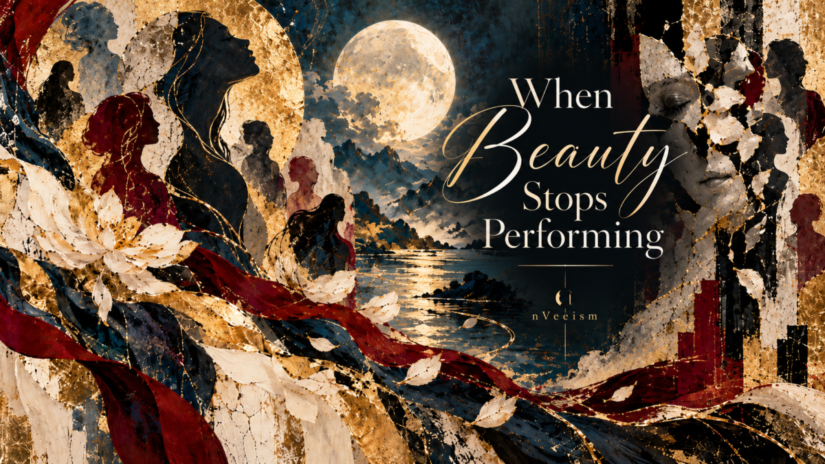
When Beauty Stops Performing
The rarest form of beauty may have very little interest in proving that it is beautiful. It does not enter the room demanding witnesses. It does not collapse when attention moves somewhere else.
It simply remains: present, human, imperfect, whole.
Perhaps that is why certain people, conversations, and creative exchanges remain with us long after they end—not because someone satisfied an imaginary standard, but because their presence challenged us to think differently.
Sometimes beauty is not what captures the eye.
Sometimes beauty is what changes the way we see.
Explore More
Continue through KVI Network’s Art & Visual Philosophy, Beauty, and Spoken Word collections. You can also explore the broader nVeeism portfolio at KVI Network, visit my nVeeism artist page, read more of my writing, view my art, or continue through the media archive on the official Nelly Vee artist site.
References
Gunnery, S. D., & Ruben, M. A. (2016). Perceptions of Duchenne and non-Duchenne smiles: A meta-analysis. Cognition and Emotion, 30(3), 501–515.
Jung, C. G. (1968). Psychology and alchemy (R. F. C. Hull, Trans.; 2nd ed., Collected Works, Vol. 12). Princeton University Press.
— Nelly Vee
Discover more from KVI Network
Subscribe to get the latest posts sent to your email.