A Nelly Vee Reflection · Language · Relationships · ChronicleS
What if “complicated” is sometimes just the word we use when we have not understood the complexity yet?
A conversation about one of my songs changed the way I heard two everyday words: complex and complicated.
The question
“Why are women so complicated?”
Her answer
“I’m not complicated. Maybe complex.”
It Started With a Song—and a Question
Me and a coworker were talking about one of my songs, “Seven Digit Combination,” from my album ChronicleS — Where Shadows Breathe.
The song came from questions about relationships, communication, attraction, frustration, vulnerability, and the challenge of trying to understand another person.
During that conversation, I asked her why women were so complicated.
She did not accept the label.
She told me that she was not complicated. Maybe complex—but not complicated.
Hmm.
That distinction stayed with me. Days later, I still think about it. Because the conversation turned out to be about much more than women, men, relationships, or even the song. It became a question about language itself.
Listen While You Read
“Seven Digit Combination”
The song sits behind this reflection as more than background music. Its central metaphor—a combination that must be understood in the right relationship and sequence—became a useful way for me to think about people, perception, and the words we use to describe each other.
The Language Question
Complex and Complicated: Similar, but Not Always the Same
In ordinary dictionary use, complex and complicated overlap quite a bit. Both can describe something made of many connected parts or something difficult to understand. So my coworker was not pointing to a rigid dictionary wall between the two words.
But there is a useful distinction in systems thinking and problem-solving. A complicated problem can often be broken into parts, studied, and addressed through expertise and a systematic process. A complex situation contains interacting parts whose relationships can change outcomes, making the whole less predictable and more dependent on context.
Complicated
Many parts. Difficult—but often traceable.
Think instructions, mechanisms, procedures, or problems that can often be separated into smaller pieces and worked through step by step.
Complex
Many relationships. Context changes the outcome.
The parts interact. Memory, timing, environment, behavior, expectations, and other forces can affect one another in ways that are not always predictable.
Important: In everyday conversation, the words are still often used as synonyms. The distinction becomes more useful when we are talking about systems, behavior, relationships, or changing human situations.
The Turn
Maybe I Was Asking the Wrong Question
Looking back, perhaps the most interesting question was never:
Why are women so complicated?
Maybe the better question is:
Why do we sometimes call people complicated when we do not understand them?
But sometimes that label tells us as much about our interpretation as it does about the other person.
The Metaphor
The Seven-Digit Combination
A combination lock can frustrate you when you do not know the sequence. You can possess all the correct numbers and still fail to open it.
Why?
Because the individual pieces are not enough. Relationship matters. Sequence matters. Context matters. Timing matters.
Human beings can be like that.
You may know someone’s history. You may know what they enjoy, what they fear, what they say they want, and how they usually react. Then one day, they surprise you.
That does not automatically mean they are “complicated.” It may mean you were working with an incomplete map of a complex human being.
For the original poem, song story, and emotional metaphor behind the combination, read Behind the Code: Unlocking the Meaning of Seven Digit Combination. The track also belongs to the ChronicleS — Where Shadows Breathe album experience.
We Throw Words Around Freely
The conversation made me think about how casually we label people.
We use words such as toxic, difficult, weak, strong, independent, sensitive, complicated, good, and bad as if one word can summarize an entire person.
Sometimes a label is useful. Sometimes it is necessary.
But a label can also become intellectual laziness.
One word can replace an entire human being—if we stop asking questions once the label feels convenient.
Once we decide someone is “complicated,” we may begin interpreting everything they do as proof of the label. Every disagreement becomes evidence. Every question becomes evidence. Every emotional response becomes evidence.
Complexity Is Not Necessarily a Flaw
A complex person can contain qualities that appear contradictory without being dishonest or defective.
Human beings are shaped by memory, culture, personality, family, beliefs, disappointments, hopes, environment, timing, experience, and circumstances. Those forces interact. That is complexity.
And Men Do Not Get a Free Pass
My original question focused on women, but reflection has to be fair.
Men are complex too.
Sometimes men call women complicated while carrying emotions we have not explained, fears we have not acknowledged, expectations we never communicated, and experiences we have not fully processed ourselves.
Then two complex human beings enter a relationship and each wonders why the other person is so difficult to understand.
Maybe the mystery is not male or female. Maybe the mystery is human.
The Words We Choose Shape What We See
That short conversation with my coworker changed the way I heard two ordinary words.
She could have laughed at my question or simply accepted my description. Instead, she corrected the frame:
Not complicated. Maybe complex.
Words shape perception. Perception influences judgment. Judgment influences how we respond to people.
Before using the label, ask:
- What am I actually observing?
- What does this word really mean?
- Does the definition fit the person or situation?
- Am I describing them—or describing my difficulty understanding them?
- What context might I be missing?
Visual Philosophy
From Language to nVeeism
This reflection fits naturally into nVeeism, where writing, memory, psychology, philosophy, symbolism, and lived experience are transformed into a visual world.
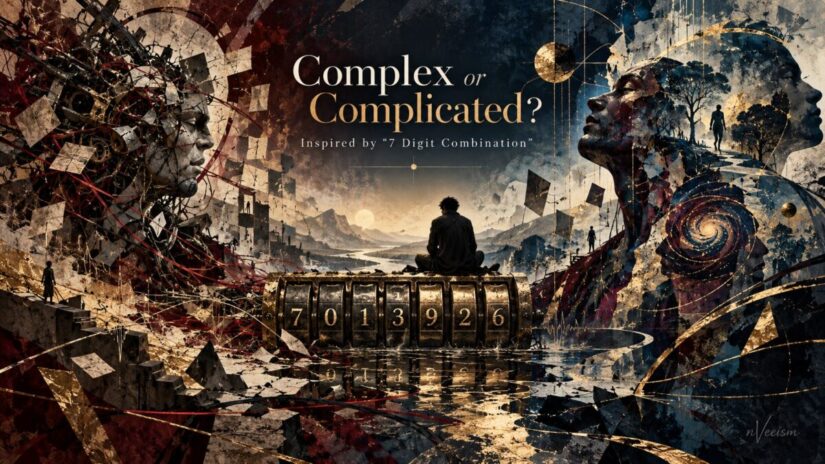
The accompanying nVeeism artwork uses the seven-digit lock as a central symbol. One side leans toward mechanical entanglement—something difficult to untangle. The other opens into layered human forms, memory, movement, and interconnected meaning.
The image is not meant to define the words. It visualizes the tension between trying to solve a person and trying to understand a person.
Ponder This
How many times have we called someone complicated when what we really meant was:
“I haven’t learned their combination yet.”
And maybe understanding another person was never supposed to be a matter of cracking a code anyway.
Continue the Story
Read the story behind “Seven Digit Combination”
Explore ChronicleS — Where Shadows Breathe
References & Further Reading
Discover more from KVI Network
Subscribe to get the latest posts sent to your email.