

Krafty Page ChronicleS • Issue 3 • June — Speak • Stage III: Emergence
You Are Seen
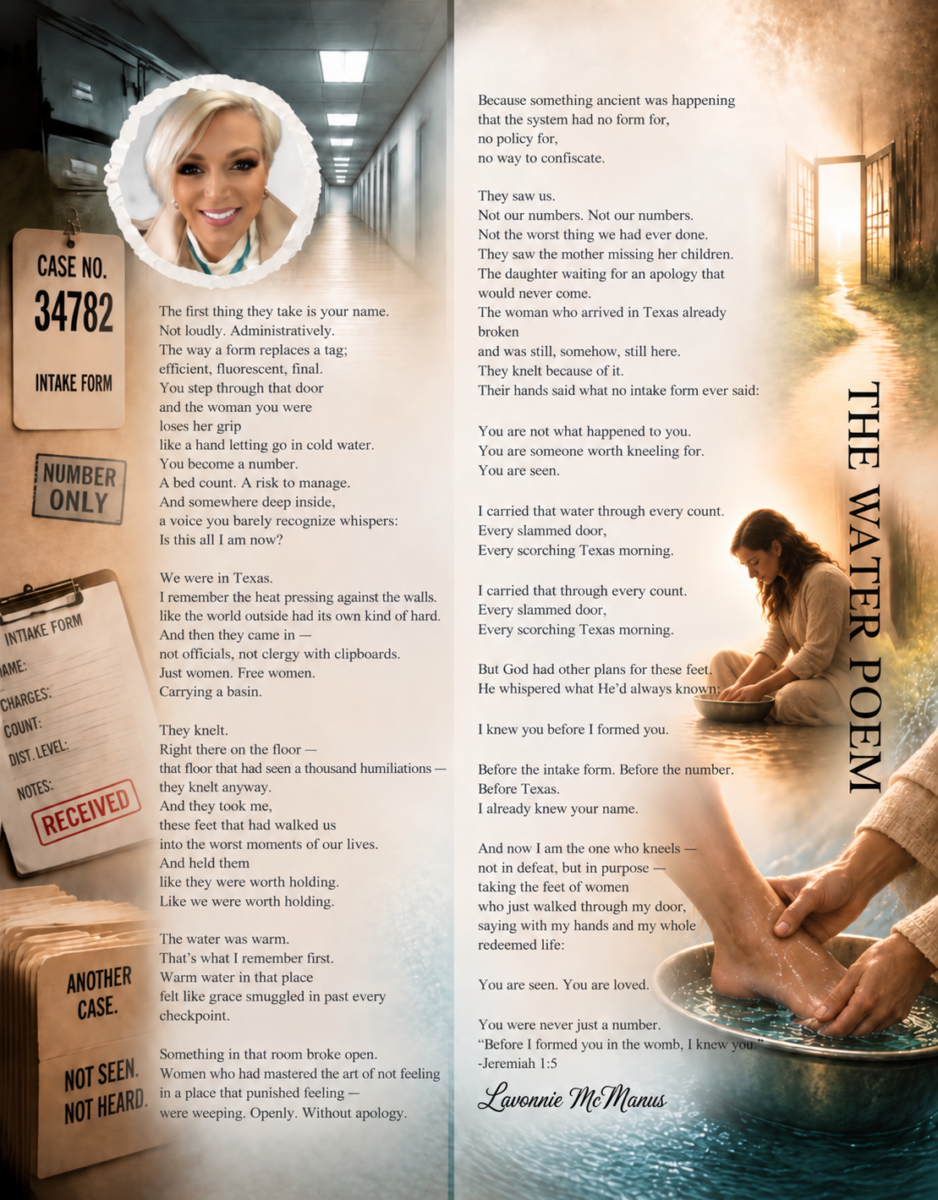
A reflection on Lavonnie McManus’s The Water Poem
Reflection by Võ Thị Như Mai • Co-Editor, Krafty Page ChronicleS
NAMED
RESTORED
Featured Work

Writer • Advocate • Reentry Professional
Lavonnie McManus
Lavonnie McManus serves as Economic Mobility Program Manager with The ZONE Spokane. Her public staff biography notes a B.A. in Psychology, an A.A. in social work, and experience in peer counseling, supportive employment, supportive housing, homelessness services, and reentry programming.
Biographical context: The ZONE Spokane — Staff.
01 • Identity
The First Thing a System Can Take Is Your Name
Reading The Water Poem, I kept returning to one idea: a human being can be surrounded by records and still remain unseen. A system can know a number, a date, a risk level, a charge, or a history without knowing the person who is carrying all of it.
That is what makes Lavonnie’s poem reach beyond incarceration. Her earlier KVI piece, Still I Rise (For My Son), also speaks from lived experience shaped by motherhood, faith, recovery, and resilience. Many of us have experienced moments when one fact about our lives became larger than everything else—our mistake, our illness, our job, our family role, our grief, our reputation. The poem asks what happens when a label begins to replace a name.
“You are seen.”
A brief line in the poem, but one that changes the direction of the entire piece.
02 • Recognition
Being Seen Is Not the Same as Being Watched
A person can be watched closely and still not be recognized. Rules can record movement, behavior, compliance, appointments, and deadlines. Recognition is something else. Recognition notices fear, effort, grief, dignity, and the human being underneath the record.
In Lavonnie’s poem, the act of washing feet becomes a counter-language to institutional reduction. It says: you are more than what has been written about you. You are worthy of care. You are still a person whose name matters.
Reflection
Sometimes dignity returns in very small ways: someone remembering your name, sitting beside you, listening without rushing, or refusing to speak to you as if your worst day is your whole identity.
03 • Faith & Service
When the Person Who Needed Care Becomes the One Who Gives It
The poem’s deepest movement comes when memory becomes service. The speaker is no longer only remembering being cared for; she becomes someone who offers care to others. The past has not disappeared, but its meaning has changed.
Lavonnie’s professional work gives that movement another layer. Her public biography describes years of reentry, supportive employment, supportive housing, peer counseling, homelessness services, and economic mobility work. That does not make hardship necessary or good. It does show how lived experience can become a form of knowledge that helps another person find a way through. KVI has explored that same principle through its “Incarcerated” Writing Prompt Competition recap, where writing becomes a way to make experience visible rather than reduce a person to a record.
There is something powerful in that transformation: the person once processed by a system becomes someone capable of helping others navigate one. The number becomes a name again—and then becomes a voice.
04 • Emergence
Why This Belongs in June — Speak
The June — Speak chapter of Issue 3 is about voice after silence: truth spoken after suppression, identity reclaimed after reduction, and lived experience transformed into language. The Water Poem belongs here because it refuses to let a record have the final word about a person.
Lavonnie’s poem speaks from the place where names, dignity, memory, service, and faith begin pushing back against labels. That is not only survival. It is emergence—and part of the larger living Issue 3 journey from awakening to becoming.
Reflection Prompt
Who Are We When the Label Is Removed?
What name, role, mistake, diagnosis, expectation, or record have you allowed to become too large in your own story—or in the way you see someone else? What changes when the person comes before the label?
Issue 3 Connection
This feature belongs in June — Speak • Stage III: Emergence, where survival, truth, voice, and reclaimed identity move into the foreground.
Share this:
- Share on Facebook (Opens in new window) Facebook
- Share on X (Opens in new window) X
- Share on LinkedIn (Opens in new window) LinkedIn
- Share on Pinterest (Opens in new window) Pinterest
- More
- Share on Reddit (Opens in new window) Reddit
- Share on X (Opens in new window) X
- Share on Tumblr (Opens in new window) Tumblr
- Share on Threads (Opens in new window) Threads
- Share on Telegram (Opens in new window) Telegram
- Share on WhatsApp (Opens in new window) WhatsApp
- Print (Opens in new window) Print
- Email a link to a friend (Opens in new window) Email
- Share on Mastodon (Opens in new window) Mastodon
- Share on Nextdoor (Opens in new window) Nextdoor
- Share on Bluesky (Opens in new window) Bluesky
Discover more from KVI Network
Subscribe to get the latest posts sent to your email.