
KPC Issue 3 · Metamorphoses · July: Flight
Reflection: Nelly Vee · Original poetry: Linette Rabsatt · nVeeism artwork: Nelly Vee
KRAFTY PAGE CHRONICLES / METAMORPHOSES / JULY: FLIGHT
From surviving to becoming.
From freedom to legacy.
A literary and nVeeism reflection on Linette Rabsatt’s I Am a Butterfly, interpreted by Nelly Vee.
FOUR MOVEMENTS OF BECOMING
01 / CATERPILLAR
Survival
02 / PUPA
Becoming
03 / BUTTERFLY
Freedom
04 / FUTURE
Legacy
Hear the poet’s voice before the reflection
Linette Rabsatt performs I Am a Butterfly from the Voices Unbound Anthology.
When the Butterfly Speaks, What Do We Hear?
We admire the butterfly for its beauty, but rarely contemplate the vulnerability and uncertainty that precede its flight. We see wings and movement. We do not always think about the caterpillar navigating danger or the pupa suspended between what was and what may come.
Virgin Islands poet Linette Rabsatt uses the butterfly’s life cycle as the structure for I Am a Butterfly, a poem that moves from struggle through solitude toward freedom and generational legacy. Rabsatt explicitly identifies the butterfly’s life stages as an inspiration for her writing (Rabsatt, 2025).
Is transformation measured by how different we appear once we emerge—or by how differently we participate in the world after our emergence?
As a Caribbean creative and publisher, this is the question I hear beneath the poem’s progression.
01 / SURVIVALThe Caterpillar: Survival Before Self-Discovery
Rabsatt begins with difficulty rather than spectacle. Her caterpillar faces an environment that requires caution and the search for nourishment (Rabsatt, 2025). Before it can embody the freedom we associate with a butterfly, it must inhabit a stage defined by vulnerability.
Human life contains seasons like this. We may be managing financial pressure, family responsibilities, uncertainty, grief or unfamiliar circumstances. Immediate demands can consume so much attention that imagining a different future feels like a luxury.
It is tempting to describe an earlier self only through limitation: I was afraid. I was not ready. I had not become enough. Yet a caterpillar is not a failed butterfly. Its stage is neither a mistake nor the complete meaning of its existence.
This is not an argument that suffering is necessary or inherently beneficial. Hardship can be senseless and preventable. The more careful insight is that hardship does not have to define the outer limit of everything a person may later learn, choose or create.
Caterpillar · The Question
How do I live through a difficult chapter without mistaking it for the whole book?
02 / TRANSITIONThe Pupa: The Loneliness of Becoming
The pupa stage is the quiet psychological center of the poem. Rabsatt associates this period with loneliness and patient anticipation (Rabsatt, 2025). This is an evocative image of an experience that human beings struggle to explain: the interval between identities.
Sometimes we outgrow familiar descriptions before discovering new language for ourselves. A role, relationship or belief may no longer fit, while the next version of our life remains uncertain. People around us may keep addressing the person they remember even as we are questioning what that description leaves out.
The loneliness of becoming is not necessarily the absence of company. It may be the difficulty of communicating a change that we ourselves cannot yet describe. From the outside, very little may appear to be happening. Inside, assumptions may be shifting, old habits may be losing their hold and new priorities may be emerging.
But patience requires discernment. Unlike a butterfly, a person follows no inevitable timetable toward maturity. Isolation can become harmful, and staying in a damaging situation does not prove strength. Reflection, support and deliberate decisions are often necessary parts of a healthy transition.
The pupa raises a question worth sitting with: What is changing within me that cannot yet be recognized through the expectations of others?
03 / EMERGENCEThe Butterfly: Freedom Is More Than Escape
When the butterfly emerges, the poem’s energy changes. Its world is now associated with motion and a wider sphere of activity (Rabsatt, 2025). The environment has not ceased to exist; the speaker’s relationship to it has changed.
We often imagine freedom as the complete disappearance of conflict. In practice, freedom can mean developing the voice to express an idea, the capacity to decline an unsuitable demand, the confidence to make a decision or the opportunity to create something once thought impossible.
The wings become an image of expanded possibility, not a promise of perfection. The new form belongs to the same continuous life as the earlier stages. Its history has not been erased, even if that history no longer controls every future movement.
There is another question here: Do we want freedom because we hope never to encounter difficulty again, or because we want to participate in life with more agency, judgment and purpose?
04 / CONTRIBUTIONPollination: When Growth Reaches Beyond the Self
One of the poem’s most important choices is the reference to pollination. Emergence is followed not merely by self-admiration but by participation in the surrounding world (Rabsatt, 2025). That detail shifts the meaning of the entire poem.
A writer develops a voice and offers language that helps someone else recognize an emotion. An educator translates experience into an opportunity for learning. An artist creates a visual form through which another person can approach a difficult question. A community administrator creates room for contributors who may not otherwise find a welcoming platform.
None of this means that human worth depends on constant usefulness. Rest, privacy and art made for its own sake are valuable. Still, pollination offers a compelling analogy: the benefits of personal growth may travel farther than the person who experiences it.
We cannot always measure the effects of a poem, painting, lesson or sincere conversation. Another person may carry an insight into places we will never see. In that sense, creative work can participate in a future that extends beyond its creator.
05 / LEGACYFuture Legacy: What Do Our Wings Leave Behind?
Rabsatt closes by looking toward a future generation (Rabsatt, 2025). The final movement transforms the question from “Who have I become?” to “What may continue because I was here?”
Legacy is often reduced to money, family lineage or public recognition. Yet it can also be a preserved story, a cultural memory, a lesson, an honest conversation, a page in a magazine or a door opened for another creative voice. It need not require fame or parenthood.
This is where I connect Linette’s poem to the wider KVI publishing mission. She is a contributor to both Krafty Page ChronicleS Magazine Volume I and Volume II, available through the KPC magazine collection. She also serves as an Administrator of Cultures of Art, Poetry & Stories (C.A.P.S.), our separate Facebook literary community. Those creative and community contributions give this reflection a living context.
KPC Issue 3: Metamorphoses — Lives in Translation organizes its July chapter around flight, wisdom, becoming and legacy (KVI Network, 2026). Linette’s poem speaks directly to those themes. It reminds us that a literary community does more than collect individual achievements. It helps one person’s voice reach another person’s imagination.
The final question is therefore not only whether we have gained our wings. It is what kind of world our movement helps cultivate.
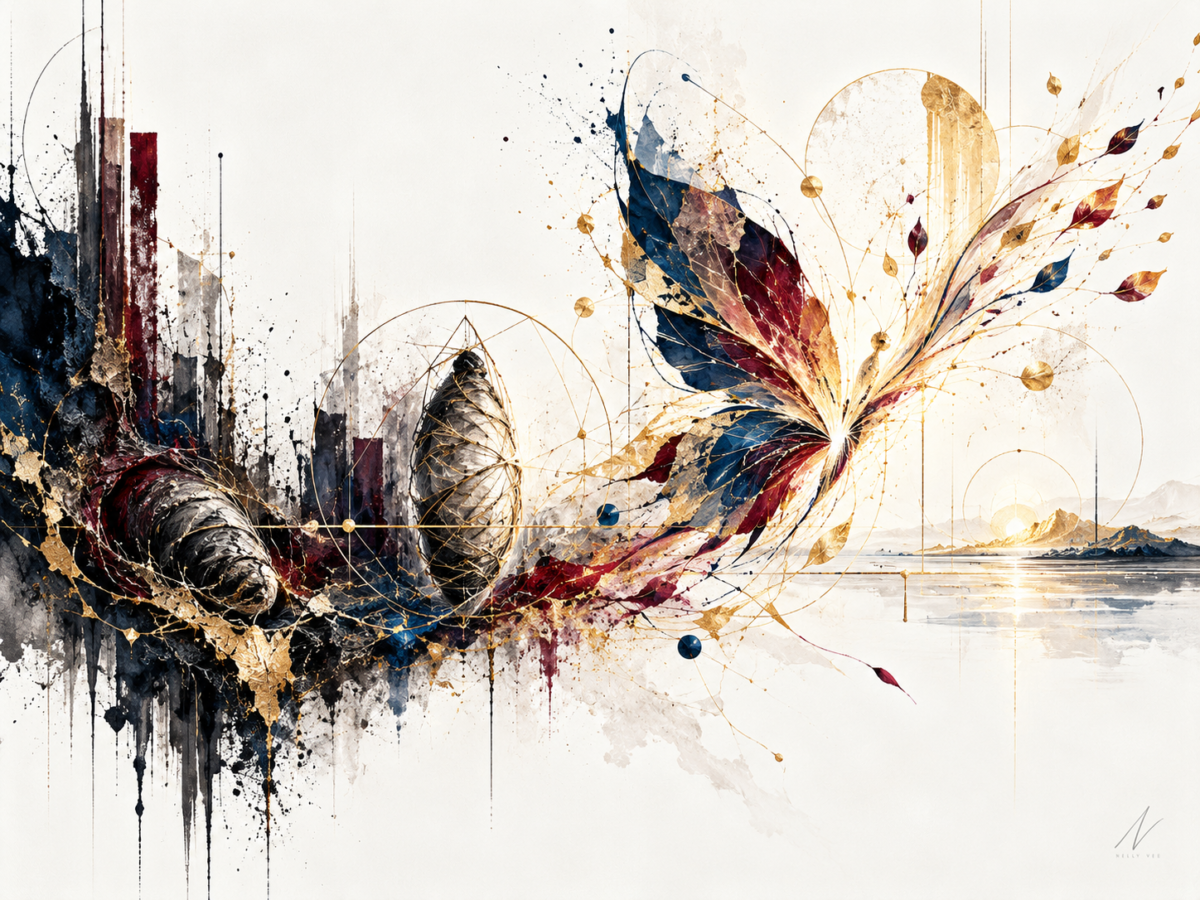
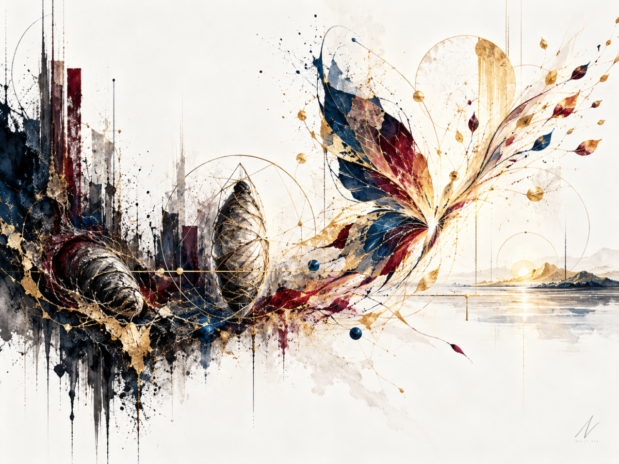
From Shadow to Golden Flight · nVeeism artwork by Nelly Vee, inspired by Linette Rabsatt’s I Am a Butterfly.
The nVeeism Interpretation: From Confinement to Consciousness
My nVeeism response to I Am a Butterfly is an abstract psychological and philosophical visual narrative, not a literal illustration of an insect.
The composition begins with dense navy, burgundy and charcoal forms. Fragmentation and visual pressure evoke the caterpillar’s vulnerable stage. A contained transitional form suggests the pupa’s uncertainty. The outward motion of marred gold and open white space suggests emergence, freedom and influence.
The earlier forms do not vanish completely. Their elements reappear within the emerging motion, as if the past has become part of a larger language instead of remaining the only story that can be told. The white gallery space creates room for that change to be visible without implying that every unanswered question has disappeared.
This is what I mean when I describe nVeeism as the poem becoming an abstract psychological and philosophical world: the poem’s emotional progression is translated through pressure, line velocity, negative space, asymmetry and visual consequence.
Original nVeeism interpretation and artwork: Nelly Vee, inspired by Linette Rabsatt’s poem.
06 / CONTINUANCEFinal Reflection: Becoming Is Not the Finish Line
There is a temptation to imagine transformation as a single triumphant moment: the wings open, the world applauds and the story ends. Linette does not let the poem stop there (Rabsatt, 2025). Its closing movement reminds us that emergence can be the beginning of another responsibility and another possibility.
Our difficult beginnings may be real without being permanent definitions. Our uncertain transitions may deserve patience without requiring silence or isolation. Our freedom may be deeply personal and still have the capacity to influence another life.
Perhaps the deepest transformation is discovering not simply that we have wings, but that our flight can help other things grow.
— Nelly Vee
About the Poet: Linette Rabsatt
Linette Rabsatt is a Virgin Islands poet with roots in the British and U.S. Virgin Islands (Rabsatt, 2025). She contributes to Krafty Page ChronicleS Magazine Volumes I and II, serves as an Administrator of the separate Cultures of Art, Poetry & Stories (C.A.P.S.) Facebook group, and shares poetry and personal reflections through Words of Ribbon.
Explore Linette’s earlier KVI features: “We Are Harvest”, “A Prayer for Women” and the “Incarcerated” writing prompt recap.
Watch the Poet: “I Am a Butterfly”
Linette’s full performance is embedded near the beginning of this reflection. Watch it directly on YouTube, read the Silver Birch Press publication and author’s note (Rabsatt, 2025), and visit Linette’s own Words of Ribbon post featuring “I Am a Butterfly”.
Explore More From KVI Network
Read KPC Volume I, explore Volume II in the magazine collection, and enter KPC Issue 3: Metamorphoses. For a related July reflection, visit Nelly Vee’s response to Victoria Kenanda’s “The Universe Always Wins”.
References
KVI Network. (2026). Krafty Page ChronicleS Issue 3: Metamorphoses — Lives in Translation. https://kvinc.org/kpc-issue-3pub/
Rabsatt, L. (2025, November 11). I am a butterfly [Poem and author’s note]. Silver Birch Press. https://silverbirchpress.wordpress.com/tag/virgin-islands/
Rabsatt, L. (n.d.). I am a butterfly [Video]. YouTube. https://www.youtube.com/watch?v=r0hJJC_5bdc
Rabsatt, L. (n.d.). Words of Ribbon [Blog]. https://wordsofribbon.blogspot.com/
Discover more from KVI Network
Subscribe to get the latest posts sent to your email.