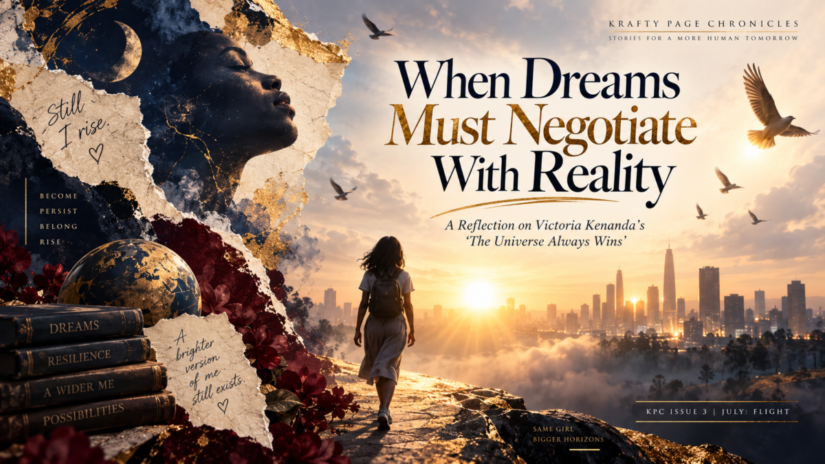

KPC ISSUE 3: METAMORPHOSES | JULY: FLIGHT
An editorial reflection on Victoria Kenanda’s “The Universe Always Wins”
Reflection by Nelly Vee
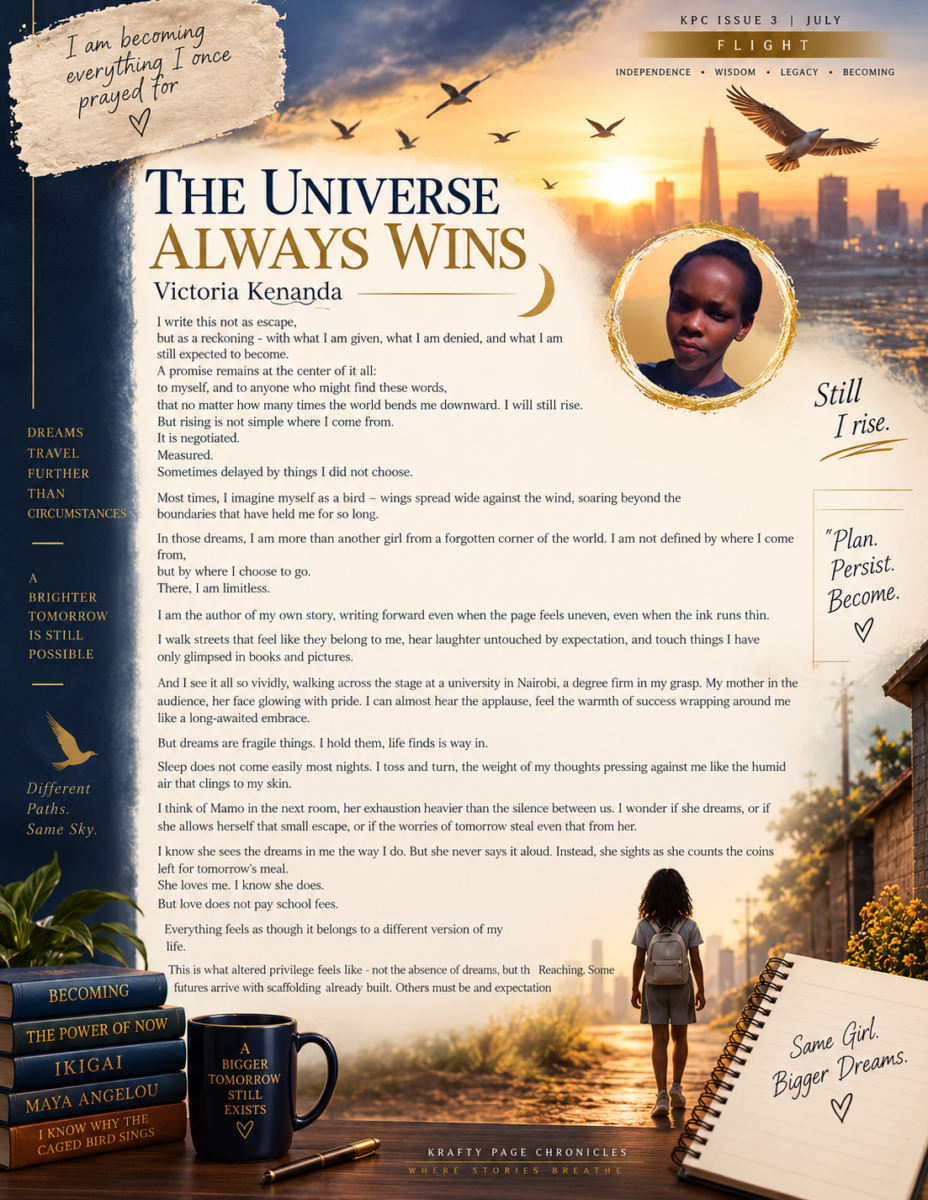
The Invisible Cost of Becoming
There is something profoundly human about dreaming beyond the circumstances that introduced us to the world. We do not choose the resources available to our families, the expectations waiting for us, or the limitations we encounter before we can even name our ambitions. Yet somewhere within those conditions, we begin to imagine a different future.
Reading Victoria Kenanda’s “The Universe Always Wins,” I found myself considering more than a young person’s desire to succeed. I encountered the tension between the life we are living, the life others expect us to accept, and the life we quietly believe may still be possible. The speaker imagines university, independence, and a future large enough to hold her own choices. But that vision does not exist in a world untouched by financial pressure or family responsibility (Kenanda, 2026).
We often call this perseverance. I think we should also ask what perseverance is being asked to carry.
The Unequal Architecture of Dreams
Dreams do not arrive with equal access to opportunity. One student may imagine a degree and immediately begin planning the next semester. Another may imagine that same degree while wondering whether the household can meet tomorrow’s needs. The ambition may be similar; the distance between desire and possibility is not. UNESCO’s education monitoring identifies poverty and socioeconomic disadvantage among the barriers that continue to shape who can participate in and complete education (UNESCO, 2024).
Too often, we admire an eventual success without examining the circumstances through which someone had to move to reach it. We celebrate the finish line while overlooking the uneven ground beneath the journey. To acknowledge that unevenness is not to dismiss personal responsibility. It is to recognize that responsibility alone cannot explain every outcome.
In Victoria’s piece, the dream of Nairobi and the university stage is vivid because it is not merely a wish for recognition. I read it as a wish to move through the world with a freedom that has not always been available. Education represents knowledge, certainly, but also the chance to make choices that once belonged mostly to imagination (Kenanda, 2026).
When Love Is Present but Opportunity Is Not
One sentence stayed with me: “But love does not pay school fees” (Kenanda, 2026).
There is no dismissal of the mother in those words. Quite the opposite. The speaker sees her, sees the exhaustion, and senses the weight of tomorrow’s responsibilities even in the quiet of the next room. Affection is present. Sacrifice is present. What is uncertain is whether either can be converted into the material opportunity a child needs.
That distinction is worth confronting. We sometimes speak as if a loving family automatically provides everything necessary for a young person to thrive. Love can steady us, encourage us, and remind us that our lives matter. It cannot, by itself, settle every bill or open every institution’s doors.
Across different communities and cultures, families may understand this tension in different ways. Still, the question is recognizable: How does a child honor what a parent has carried without believing that gratitude requires surrendering her own future?
Perhaps one answer begins by refusing to turn love and ambition into enemies. Wanting a wider life does not mean rejecting the people who helped us imagine one.
The Bird, the Wind, and the Right to Fly
The image of a bird moving beyond familiar boundaries in Kenanda’s work gives this reflection its natural place in Issue 3’s July theme, Flight (Kenanda, 2026). But I do not see the bird simply as a symbol of escape. I see it as a question about freedom.
Wings matter. So do the wind, the weather, the distance, and somewhere safe to land. We can recognize a person’s determination without pretending that determination controls every condition surrounding the journey.
This is where the metaphor becomes psychological as well as philosophical. A person can begin to imagine herself differently long before the outside world reflects that change. Inwardly, she has already stepped beyond the identity circumstance assigned her. Outwardly, she may still be waiting for the means to move.
Becoming, then, is not always a dramatic departure. Sometimes it is the quieter decision not to let present limitations become the final definition of the self.
Does the Universe Always Win?
Kenanda’s title invites a tension I would rather examine than resolve too neatly (Kenanda, 2026). If the universe represents everything beyond our control, then there are moments when effort meets a reality it cannot immediately change. If it represents a larger unfolding of life, perhaps the outcome of a dream will not always resemble the picture we first held.
Neither interpretation requires surrender. It does, however, challenge the comforting claim that wanting something deeply enough guarantees its arrival. That claim can burden the very people it claims to encourage. When a door remains closed, they may begin to question their worth instead of recognizing the limits of the door.
I hear a different kind of resolve in this work: the refusal to confuse delay with the end of possibility. The speaker does not deny hardship. She continues to imagine a future in its presence.
Becoming Is Not the Same as Escaping
What makes “The Universe Always Wins” meaningful to me is not a promise that every dream will unfold as planned. It is the dignity of a person who insists on imagining herself beyond what has been handed to her, while remaining aware of the people and pressures that shape her journey.
We should make room for that kind of ambition without romanticizing the obstacles around it. We should celebrate effort without making hardship a prerequisite for deserving opportunity. And we should remember that a person’s beginnings may explain something about the road she has traveled, but they cannot tell us everything about who she may become.
When we encourage someone to spread her wings, do we also consider the circumstances that determine whether she has room to fly?
— Nelly Vee | KPC Issue 3: July — Flight
Explore More From Krafty Page ChronicleS
Continue reading Issue 3: Metamorphoses — Lives in Translation, explore my companion reflection on Vo Thi Nhu Mai’s “Before Dawn Arrives”, and consider another path through personal transformation in “My Heals”: Learning to Walk Through Healing.
References
Kenanda, V. (2026). The universe always wins [Poem and artwork]. Krafty Page ChronicleS, Issue 3: Metamorphoses.
UNESCO. (2024). Monitoring SDG 4. Global Education Monitoring Report. https://www.unesco.org/reports/gem-report/en/2024-monitoringsdg4
Discover more from KVI Network
Subscribe to get the latest posts sent to your email.