
Krafty Page ChronicleS • Issue 3 • May — Belong • Stage II: Chrysalis
Half Light, Half Absence
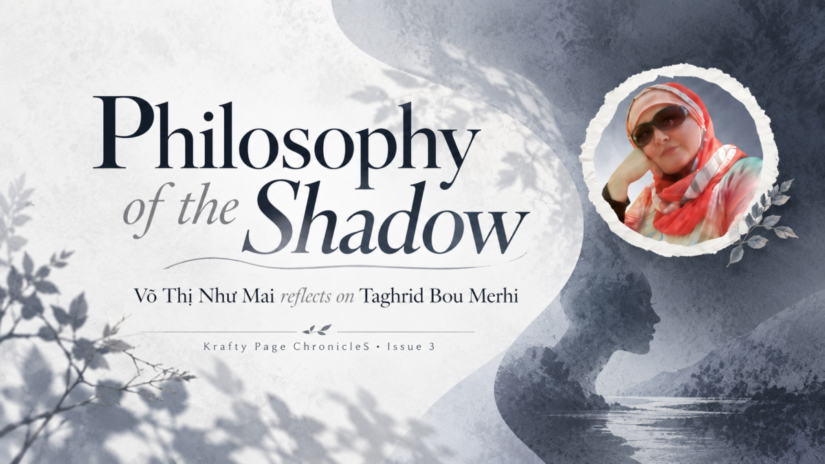
Võ Thị Như Mai reflects on Taghrid Bou Merhi’s Philosophy of the Shadow.
Reflection by Võ Thị Như Mai • Co-Editor, Krafty Page ChronicleS
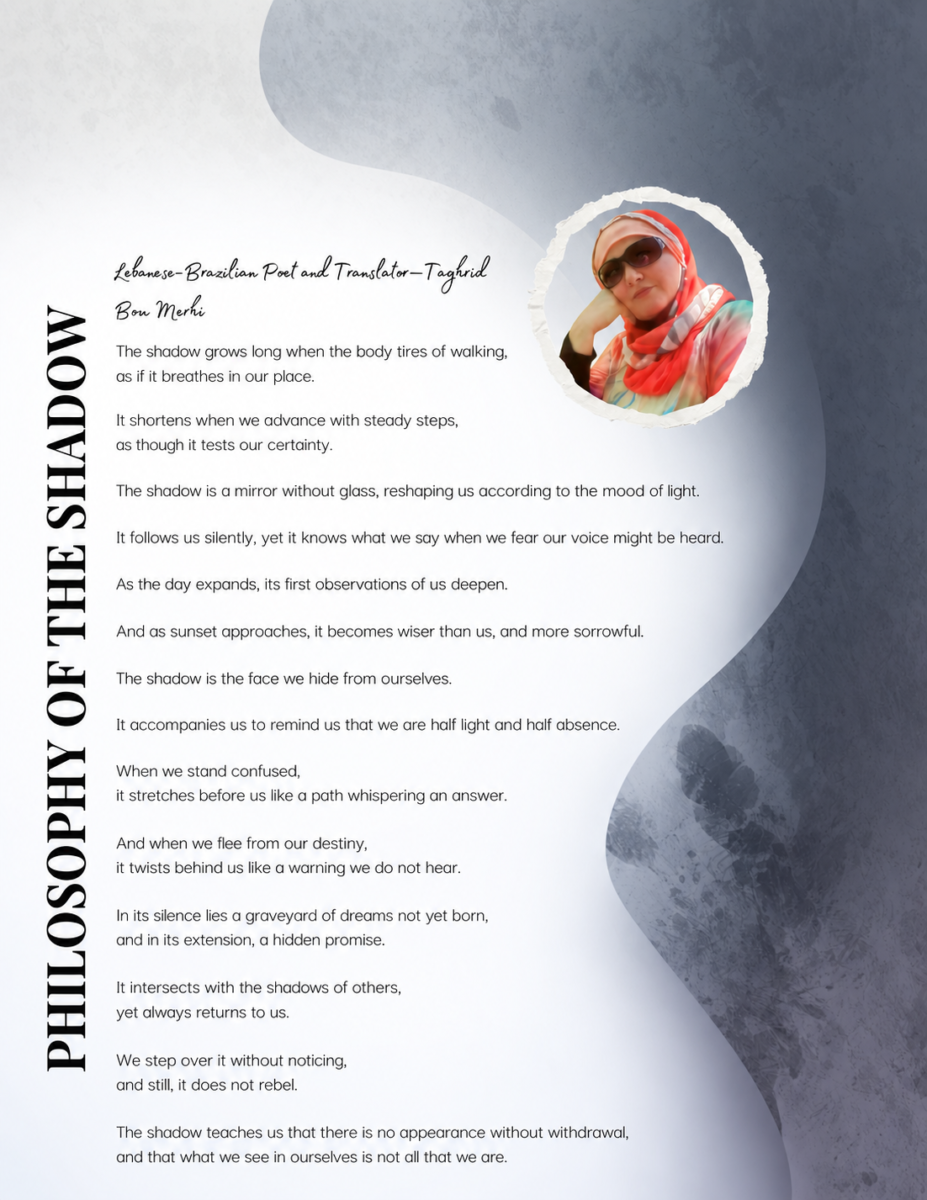
Featured Work • Taghrid Bou Merhi
Contributor Spotlight
Taghrid Bou Merhi
Lebanese poet • writer • translator • Arabic-language educator
Taghrid Bou Merhi is a Lebanese poet, writer, translator, and Arabic-language educator living in Brazil. She holds a degree in law and has built a multilingual literary practice spanning poetry, essays, translation, editing, and international cultural exchange.
Her work has appeared in international journals, anthologies, and collaborative literary projects, and her writing and translation practice reflects a sustained interest in carrying ideas across languages and cultures.
Sources: Citizen TALES Commons • 2024 interview with Taghrid Bou Merhi
The Poem at the Center
What If the Shadow Is Not the Enemy?
Taghrid Bou Merhi’s poem treats the shadow not as something frightening to destroy, but as a quiet witness. It lengthens, shortens, follows, warns, reflects, and returns. The shadow becomes a companion to the self—a presence shaped by light, yet never fully identical to the person casting it.
One line holds the poem’s philosophical tension with particular clarity: “The shadow is the face we hide from ourselves.” The image suggests that what we conceal is not always foreign to us. Sometimes it is simply a part of us we have not learned how to name.
Mai’s Lens • The Self We Do Not Announce
We Are More Than the Version Others Can See
What moves me most in this poem is its refusal to divide a person neatly into light and darkness. The shadow does not cancel the light. It exists because light is present. That relationship matters. We often speak of becoming as though growth means eliminating contradiction, but perhaps maturity is the ability to stand beside contradiction without pretending it is not there.
There are parts of a life that remain visible and parts that stay private: grief we do not explain, dreams we have not spoken aloud, memories that continue influencing us long after the moment has passed. Silence can sometimes protect dignity; at other times, it can become a place where unexamined fears grow. The poem does not tell us to expose everything. It asks us to notice what follows us.
That is why the description of the self as “half light and half absence” feels less like judgment than recognition. Human identity contains presence and omission, voice and restraint, memory and forgetting. Belonging to ourselves may require making room for all of them.
— Võ Thị Như Mai
The shadow does not prove that light has failed. It proves that light has touched something solid.
— Võ Thị Như Mai
Psychology & Symbol
The Hidden Self Is Not Always the Worst Self
The poem naturally invites comparison with Carl Jung’s idea of the “shadow.” In Jungian psychology, the shadow represents aspects of the psyche that a person does not readily accept or express consciously; importantly, those hidden qualities are not limited to what is morally negative (American Psychological Association, 2018). A person may also suppress tenderness, creativity, anger, ambition, or vulnerability when those qualities feel unsafe or unacceptable.
Bou Merhi’s poem is not simply an illustration of Jung, and it should not be reduced to one theory. Its shadow is more fluid and poetic: sometimes witness, sometimes warning, sometimes path. Yet the psychological comparison helps illuminate the same central possibility—the parts we avoid looking at may still contain information about who we are becoming.
Culture, Silence & Expression
What We Hide Is Also Shaped by the World Around Us
The meaning of silence is not identical everywhere. Culture can influence when people express emotion, when they restrain it, and what emotional behavior is considered appropriate within relationships. Research on emotion regulation shows that cultural values can shape both the motivation to regulate emotion and the meaning of that regulation (Ford & Mauss, 2015).
That does not mean any culture produces one kind of person. Individuals differ within every community. But it does remind us that the hidden self is never formed in isolation. Families, relationships, language, social expectations, migration, and memory can all influence which parts of ourselves become easy to show—and which remain in shadow.
The Personal Question
What Follows You Quietly?
Which part of yourself appears most clearly when no one is asking you to perform, explain, or prove anything?
The Relational Question
Which Selves Are Welcome?
Do the people around you make room for complexity, or only for the version of you they already understand?
Reader Reflection
What Would Change If You Stopped Treating Every Hidden Part of Yourself as Something to Fear?
The poem leaves us with a difficult but compassionate possibility: self-knowledge is not the same as self-exposure. We do not have to display every wound or private thought. But we can learn to recognize the shadow without pretending it belongs to someone else.
Issue 3 Connection
May — Belong • Stage II: Chrysalis
Philosophy of the Shadow belongs in May because belonging begins before community can recognize us. It begins with the harder question of whether we can belong to our own complexity. The poem explores identity as something layered—visible and hidden, illuminated and withheld.
References
American Psychological Association. (2018). Shadow. APA Dictionary of Psychology. APA Dictionary of Psychology.
Ford, B. Q., & Mauss, I. B. (2015). Culture and emotion regulation. Current Opinion in Psychology, 3, 1–5. https://doi.org/10.1016/j.copsyc.2014.12.004.
Share this:
- Share on Facebook (Opens in new window) Facebook
- Share on X (Opens in new window) X
- Share on LinkedIn (Opens in new window) LinkedIn
- Share on Pinterest (Opens in new window) Pinterest
- More
- Share on Reddit (Opens in new window) Reddit
- Share on X (Opens in new window) X
- Share on Tumblr (Opens in new window) Tumblr
- Share on Threads (Opens in new window) Threads
- Share on Telegram (Opens in new window) Telegram
- Share on WhatsApp (Opens in new window) WhatsApp
- Print (Opens in new window) Print
- Email a link to a friend (Opens in new window) Email
- Share on Mastodon (Opens in new window) Mastodon
- Share on Nextdoor (Opens in new window) Nextdoor
- Share on Bluesky (Opens in new window) Bluesky
Discover more from KVI Network
Subscribe to get the latest posts sent to your email.