Lotus Reflection · Mai White
A reflective journalistic reading of “In Celebration Featuring Nelly Vee” — April 11, 2026

Some interviews tell us what a person has accomplished. Others allow us to see how that person became who they are.
As I watched In Celebration Featuring Nelly Vee, I found myself listening not only to the answers, but also to the spaces around them—the pauses, the nervous laughter, the moments when language seemed easier to feel than to speak.
That became, for me, the heart of the conversation.
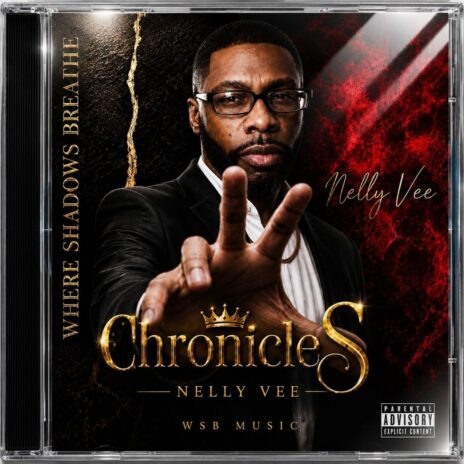
Nelly Vee entered the program as an author, poet, entrepreneur, publisher, and founder of KVI Network Creations. Yet the interview quickly moved beyond titles. Host Anjetta “Anjie” Williams-Brown and co-host Artemus created room for something quieter: a portrait of a man who has built much of his creative life around helping other people be seen, while still learning how to stand comfortably inside the light himself. KVI readers can also encounter Williams-Brown through Mai White’s reflection on her poem If I Were a Shapeshifter.
Sometimes the person who creates space for everyone else is the least prepared to become the center of the room.
Watch the original In Celebration feature on YouTube →
When Speaking Becomes More Difficult Than Writing
One of the most human moments came early.
Nelly was asked to explain what he meant by working at the intersection of poetry, design, leadership, and lived experience. He knew what he wanted to say. The idea was clear inside him. But speaking it aloud became difficult.
The hosts noticed.
Instead of pushing him forward, they changed the environment. Cameras were turned off. The room became less visible, less performative, and perhaps a little safer.
Then his thoughts began to open.
I found that moment important because it challenges our usual idea of confidence. We often imagine leadership as a loud voice, an immediate answer, a person who enters a room without hesitation. But what about the reflective leader? The writer who has spent years placing thought onto paper before offering it to the world? The person whose silence is not emptiness, but processing?
Nelly later explained that writing became his way of expressing what he once felt people did not hear.
That sentence stayed with me.
For many writers, the page is not merely a place to create. It is the first place where they feel uninterrupted.
Poetry, Design, Leadership, and Lived Experience
As the interview unfolded, Nelly’s description of his creative philosophy began to make sense as one connected system.
Poetry is how he processes life.
Design is connected to color, visual memory, painting, culture, and the many traditions that surrounded him growing up.
Leadership comes from a lifetime of responsibility.
Lived experience is the ground beneath all of it.
These are not separate compartments. They meet.
That meeting point is visible across the wider KVI creative ecosystem, where literature, publishing, music, visual expression, cultural storytelling, and community recognition increasingly overlap.
I have always believed that meaningful creative work becomes strongest when it refuses to remain trapped inside one definition. A poem can become an image. An image can become memory. A memory can become a story. A story can become a bridge between people who may never otherwise have met.
This interview reveals that Nelly’s work follows much the same movement.
Love Above the Label
When Angie asked about the philosophy “love above the label,” the discussion moved into deeper territory.
Nelly spoke about growing up around abuse, discrimination, belittlement, and low self-worth. He described watching people become reduced from complete human beings into labels.
What happens when a name given by someone else becomes louder than the person carrying it?
What happens when society decides it understands someone before listening to their story?
These are not abstract questions.
They sit inside families, communities, cultures, schools, workplaces, and creative spaces everywhere.
To place love above the label is to insist that a human being must remain larger than the category placed upon them.
I also see this philosophy reflected in KVI’s emphasis on giving space to writers, artists, and creators who may not have access to the largest platforms. That idea continues through the literary and cultural work surrounding ChronicleS and the international vision of Krafty Page ChronicleS Issue 3: Metamorphoses — Lives in Translation.
Nelly said he understands what it feels like to be the “little man.”
So he tries to tell others, in the ways available to him: I see you. You matter. Your story matters.
Perhaps that is where leadership becomes service.
When Poetry Carries What Conversation Cannot
The poetry readings brought another layer into the interview.
In Bridges Between Generations, Nelly reflected on growing up in the 1980s and 1990s, when streets became classrooms, friendship was physical rather than virtual, and resilience was learned through direct experience.
Yet the poem does not simply dismiss the younger generation. It looks for the bridge.
That matters.
Nostalgia becomes most useful when it is not used as a weapon against the present. The older generation has memory. The younger generation has its own language, fears, tools, and possibilities. Stories can become the meeting place.
Then came She Writes Like I Bleed.
The emotional temperature changed.
The poem tells of a father reconnecting with his daughter after years of separation and discovering, through her poetry, something startlingly familiar: rhythm, pain, voice, survival.
There is something profound in the idea that absence can separate people physically while language preserves an invisible inheritance.
Father and daughter find one another again partly through words.
Not through perfect explanations.
Through poetry.
The hosts explained that the piece had captured their attention before friendship could influence their opinion. They encountered the writing first.
For any writer who doubts whether praise comes from affection or from the work itself, that distinction can mean a great deal.
Benjamin Blue and the Beauty of Difference
One of the gentlest stories in the interview concerned Benjamin Blue: The Streets Between Worlds, inspired by Nelly’s late Cocker Spaniel.
Benjamin had one blue eye.
At the shelter, he was loud, unusual, and immediately noticeable. Nelly wondered whether the blue eye meant something was wrong. When he learned it did not, he chose Benjamin precisely because he was different.
I smiled at that story because it quietly echoed so much of what had already been said.
Again, difference was not deficiency.
Difference became the reason to look closer.
The book also allowed Nelly to weave Caribbean influence into the story, bringing heritage into a work born from memory and affection.
This movement—from personal experience into cultural storytelling—is one of the recurring threads throughout the interview.
Why KVI Was Built as a Network
Nelly’s explanation of the KVI name also revealed something important about his intention.
The earlier KnightVision.Ink identity connected his military experience, his sense of vision, and his love of writing. But KVI Network Creations offered a wider horizon.
The word creations was deliberately broad.
Why should creativity be forced into a single form?
Writing belongs there. So does poetry. Art. Design. Music. Publishing. Storytelling. New forms that may not yet have names.
But I think the word network may be even more revealing.
Nelly spoke about a dream of bringing together stories from different races, religions, traditions, cultures, and countries. He described plans for literary collaboration and international participation.
Today, that idea feels especially relevant beside the development of KPC Issue 3 and its widening circle of contributors.
Diversity is strongest when it is not added afterward as decoration, but built into the structure from the beginning.
Leaving a Road Back Into the Story
I was also interested in Nelly’s description of his writing process.
School had reduced the time available for daily writing, so he began keeping fragments—paragraphs, ideas, unfinished pieces—and returning to them later.
He also spoke about his attraction to twists and cliffhangers.
For him, an unfinished piece is not necessarily a failure to finish. It can become a doorway back into creativity.
I like that idea.
Writers often punish themselves for incompleteness. We call it writer’s block. We call it distraction. We call it lack of discipline.
But sometimes an unfinished sentence is simply a seed waiting for another season.
Education as Another Form of Becoming
The interview also captured Nelly during an academic transition, moving through studies in leadership, communication, business, and theology.
None of these subjects feels entirely separate from the person speaking in the interview.
A writer studies language.
A publisher studies people and audiences.
A leader studies responsibility.
A theologian studies questions larger than the self.
A communicator must learn how all of those worlds speak to one another.
Perhaps education, like creativity, is not always about replacing one identity with another. Sometimes it is about finding new language for something that was already forming inside us.
Dear Younger Me
Near the end of the conversation, Nelly was asked what he would tell his younger self.
Again, he turned to the page.
His piece Dear Younger Me moves through hardship, family, Black identity, blended cultural experience, faith, belonging, and resilience.
The message is not complicated.
Stop allowing cruel voices to become your internal voice.
Believe that you can survive what feels permanent.
Understand that heritage does not have to compete inside you.
Forgive yourself for not knowing then what you know now.
Simple words can carry enormous weight when they come from experience rather than theory.
Resilience sounds different when it has been lived.
When the Celebration Turned Toward Him
By the closing portion of the program, the interview had become something else.
It became a tribute.
Participants shared art, reflections, and poems written for Nelly. Artemus connected his creative life to the meaning the hosts had associated with his name: light, brightness, the shining one.
Another friend spoke about the kind of person who does not simply sympathize with someone’s difficulty, but immediately begins looking for a way to help solve it—even trying to create opportunity where none seems to exist.
Nelly seemed moved and slightly uncomfortable.
I understood that moment.
Giving can feel natural to some people. Receiving recognition can feel strangely exposed.
But perhaps there are moments when accepting another person’s gratitude is also a form of generosity.
It allows them to say: what you did mattered to me.
The Light Behind the Vision
The opening of In Celebration included an affirmation about refusing to let other people determine one’s story.
By the end, those words seemed to have followed the entire interview.
A difficult childhood does not get to write the last line.
A label does not get to write the last line.
Fear does not get to write the last line.
Neither does invisibility.
The person living the story keeps writing.
This interview did more than place Nelly Vee in the spotlight. It allowed the person who so often holds the light for others to stand inside it for a while.
That is why I believe this conversation is worth preserving.
Not because it presents a flawless portrait. Quite the opposite.
There are connection problems. Hesitations. Nervous moments. Thoughts that arrive more easily on paper than through speech.
And that is precisely what makes it human.
We are allowed to become in public.
We are allowed to still be learning how to explain ourselves.
We are allowed to build something before we fully understand what it will become.
Perhaps the most meaningful stories are not those told after every uncertainty has disappeared, but those preserved while transformation is still happening.
Continue Exploring
Learn more about Nelly Vee and KVI Network Creations, follow the latest organizational developments through the KVI Hub, explore Krafty Page ChronicleS Issue 3: Metamorphoses — Lives in Translation, and discover how poetry, psychology, philosophy, and lived experience move into visual language through nVeeism.
For more of Anjetta “Anjie” Williams-Brown on KVI, read The Metamorphosis of Time, Mai White’s reflection If I Were a Shapeshifter, and the KPC Issue 3 — April: Create chapter where these features are indexed.
Join the Conversation
Have you ever found it easier to express something through writing, art, music, or another creative form than through ordinary conversation?
And when someone spends much of their life encouraging others, who reminds that person that their own light deserves to be seen?
Share your reflection in the comments and continue the conversation within the KVI community.
— Mai White
Source: “In Celebration Featuring Nelly Vee,” April 11, 2026. Original video: YouTube.
Share this:
- Share on Facebook (Opens in new window) Facebook
- Share on X (Opens in new window) X
- Share on LinkedIn (Opens in new window) LinkedIn
- Share on Pinterest (Opens in new window) Pinterest
- More
- Share on Reddit (Opens in new window) Reddit
- Share on X (Opens in new window) X
- Share on Tumblr (Opens in new window) Tumblr
- Share on Threads (Opens in new window) Threads
- Share on Telegram (Opens in new window) Telegram
- Share on WhatsApp (Opens in new window) WhatsApp
- Print (Opens in new window) Print
- Email a link to a friend (Opens in new window) Email
- Share on Mastodon (Opens in new window) Mastodon
- Share on Nextdoor (Opens in new window) Nextdoor
- Share on Bluesky (Opens in new window) Bluesky